








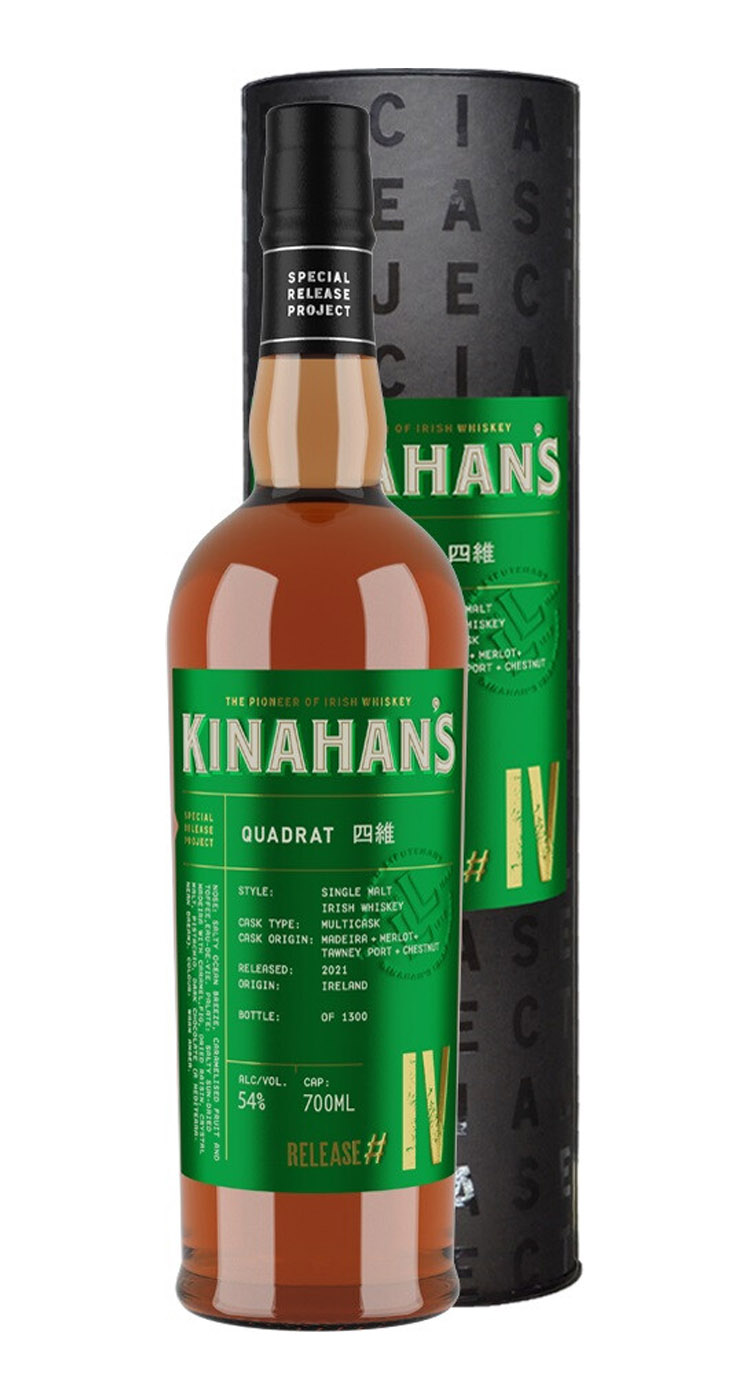

Kinahan`s Quadrat No. IV (in tube)
The whiskey is colored in a warm amber hue.
The enticing aroma of the whiskey is filled with tones of sea breeze, caramelized fruits, and toffee.
The taste of the whiskey is surprisingly multifaceted and smooth, despite its strength, complex yet harmonious. The flavor profile highlights notes of caramel, fig, dried fruits, salted nuts, and dark chocolate. The finish is long, with a delicate malty sweetness.
The whiskey is excellent as a digestif, with ice, a cigar, or in cocktails.
Specifications
- Country: Ireland
- Region: Dublin
- Manufacturer: Kinahan`s
- Alc: 54%
- Type: Single Malt
- Serving temperature: 20-22 °C
- Filtration: No cold filtration
- Type of drink: Whiskey
Interesting facts
"Kinahan`s" Quadrat No. IV is a unique Irish single malt whiskey, representing a blend of 4 distillates, each aged in its specially selected barrel. The combination of barrels is chosen based solely on the uniqueness of the taste and character of the desired drink. The goal is to combine the best and rarest to create a multifaceted blend, the components of which perfectly complement each other. For the aging of this release, barrels from Madeira, Merlot wine, Tawny Port Single Cask, and chestnut barrels were used. All distillates are then combined in one vat before bottling. Quadrat No. IV represents a certain edge between traditional flavors that have not yet faded into the past and modern flavors that are yet to emerge in the future. "Kinahan`s" Quadrat No. IV is bottled at 54% without cold filtration and caramel addition. The limited edition consists of only 1300 bottles and is dedicated to the 242nd anniversary of the "Kinahan`s" brand.
About the Manufacturer
The company Kinahan`s was founded in 1779 on Trinity Street in Dublin by Daniel Kinahan. Since then, the brand has begun its epic saga, a journey through time and an odyssey between generations. In 1980, the company acquired impressive storage facilities in Hamilton Row, Dublin, allowing barrels to be stored under proper conditions and producing aged whiskey. Thus, Kinahan’s became one of the first brands to produce and export only aged whiskeys. In 1807, the Lord Lieutenant of Ireland (head of state) Charles Lennox was so impressed with Kinahan`s whiskey that he ordered all stocks to be taken exclusively for personal use, marking each barrel "LL". This news, which gained wide publicity, led to Kinahan`s range becoming one of the most popular both domestically and abroad. In 1819, the popularity of the Kinahan’s brand allowed for the creation of its own four-story headquarters. By the mid-20th century, the historic building was destroyed. As Kinahan`s popularity grew, London became the base for international trade in the 1800s. For over half a century, the London base of the company has been the center of export trade to the continent, China, India, Australia, and other foreign markets. In 1845, Queen Victoria awarded Kinahan’s with the Royal Warrant. With the growing popularity in the British Isles by the mid-19th century, Kinahan`s whiskey gained recognition from the legendary Jerry Thomas, "the father of American mixology". The terms "Kinahan’s" and "Kinahan’s LL" by 1881 became generic, gaining wide recognition as a shorthand designation for whiskey of a certain price, quality, and reputation. One of the key family members, George Kinahan, died in 1903, marking the end of the family`s long association with Dublin`s public life. Besides the passing of George Kinahan, the company had to cope with the changing economy of Ireland. In June 1911, Kinahan’s business operations were transferred to Bagot & Hutton, another long-established winery in Dublin. This company bottled and distributed "Kinahan’s LL" whiskey until Prohibition in the USA in 1920. The company resumed operations in 2004. It currently operates several production facilities across Ireland. The new whiskey production team draws inspiration from Kinahan’s long-standing heritage, focusing on the unique characteristics of wood and various aging methods. Kinahan’s often challenges long-standing stereotypes. "Older whiskey is not always better whiskey, and age does not necessarily contribute to the maturity of aroma."
Similar products
95200 ₸
88000 ₸
80000 ₸
80000 ₸